WhatsApp
Pântano do Sul · South of Florianópolis Island · Brazil

Where the island
goes quiet.

Two architect-built homes, a short walk from the sand, facing protected forest - in the part of Florianópolis people move to when they want nature, not noise.

Per homeR$ 1,700,000 ≈ US$ 333,000*
Above the threshold for Brazil's investor residency visa - your home and your visa, in one move.
Scroll

Two architect-built homes for sale in the south of Florianópolis, Brazil - contemporary design, a short walk from the beach, facing protected Atlantic forest.

The South of the Island

Everyone knows Jurerê. Few make it this far south.

Florianópolis is really two islands wearing one name. There's the north - Jurerê Internacional, the beach clubs, the glass towers, the Ibiza-of-Brazil energy. There's the centre, Campeche, filling in fast, becoming the island's new downtown. And then there's the south: a string of fishing villages and surf beaches where the asphalt thins out, the hills close in, and the Atlantic forest comes right down to the road.

Pântano do Sul is the south's anchor - the most traditional fishing beach on the island, 2.5 km of clear sand, fishing boats still hauling mullet at one end, foot-in-the-sand restaurants at the other. Walk fifteen minutes along the shore and you reach Praia dos Açores: wilder water, surfable swell, the Três Irmãs islands on the horizon, hills of native vegetation wrapped around the bay. No high-rises. No physical division between the two beaches - just one long, uninterrupted stretch of coast.

This is the part of the island you choose on purpose. People come here for one reason above all others: the nature. And that reason isn't going away.

That's also the long game. As Campeche keeps urbanising and the north keeps pricing itself into the stratosphere, the scarce thing on this island becomes exactly what the south still has - quiet, green, untouched coastline that can't be rebuilt once it's gone. Land here doesn't just hold value. It's positioned to climb faster than the busier districts, because what it offers can't be manufactured anywhere else.
Nature on the doorstep

Trails, surf, and a beach you can walk to.

Lagoinha do Leste - one of the island's last truly secluded beaches, reachable only on foot - starts its trail right here in Pântano do Sul. Surf breaks for every level, from the forgiving sandbanks of Praia dos Açores to the heavier swell further out. Ecological trails into the surrounding morros. And the kind of evening where the only sound is the water.

Surf · Praia dos Açores

Waves on your doorstep.

A consistent beach break for every level, a short ride from the house - and it works on any tide. Full spot guide on mondo.surf.

Left & rightWave direction
SE, SBest swell
W, NW, N, NEBest wind
All tides workTide
SandSeabed
From 0.6 mBest size
Under 50 mWave length
All levelsExperience

Praia dos Açores breaks consistently across the whole tidal cycle - the sandy seabed keeps the waves working at high, mid or low tide, so you can paddle out at almost any time of day. Surf data: mondo.surf.

A community already here

The expat families found this place first.

The south of the island has quietly become home to a community of foreigners - Americans, Germans, Swiss, families raising young kids, many of them homeschooling. It's not an accident. The nearest international school is a drive away, so the people who settle here tend to be the ones building life on their own terms: remote workers, early-stage families, people who came for the forest and the ocean and decided to stay. You wouldn't be the first to make this move. You'd be joining people who already did.

Why here, not there

One island, three very different decisions.

If you're weighing Florianópolis neighbourhoods, here's the honest version.

Jurerê North

Sophistication, beach clubs, luxury mansions. Mediterranean-style and priced for it. Beautiful - but it's a scene, not a retreat.

Glamour & nightlife

Campeche Centre

Convenient, central, strong rental demand. But it's urbanising fast - becoming the island's downtown. Great for a rental-yield play, less so for getting away from it all.

Investment & convenience

The South Açores

Real nature, real quiet, real community. The long-term value play as the island fills in and untouched coast becomes the rarest thing on it. This is where you live, not where you park money.

Nature & the long game
The Home

Casas Açores - two homes, one standard of obsession.

Casa Lagoa do Perí and Casa Rio das Pacas: two semi-detached homes on a single 360 m² lot, built by AnMa Construtora - the partnership of Andrade and Mazzola, founded in 2021 on a simple idea. One partner with a sharp eye for design, taste and sophistication. The other with deep experience on the building site, obsessed with execution, durability, and the five-year guarantee on every project they deliver.

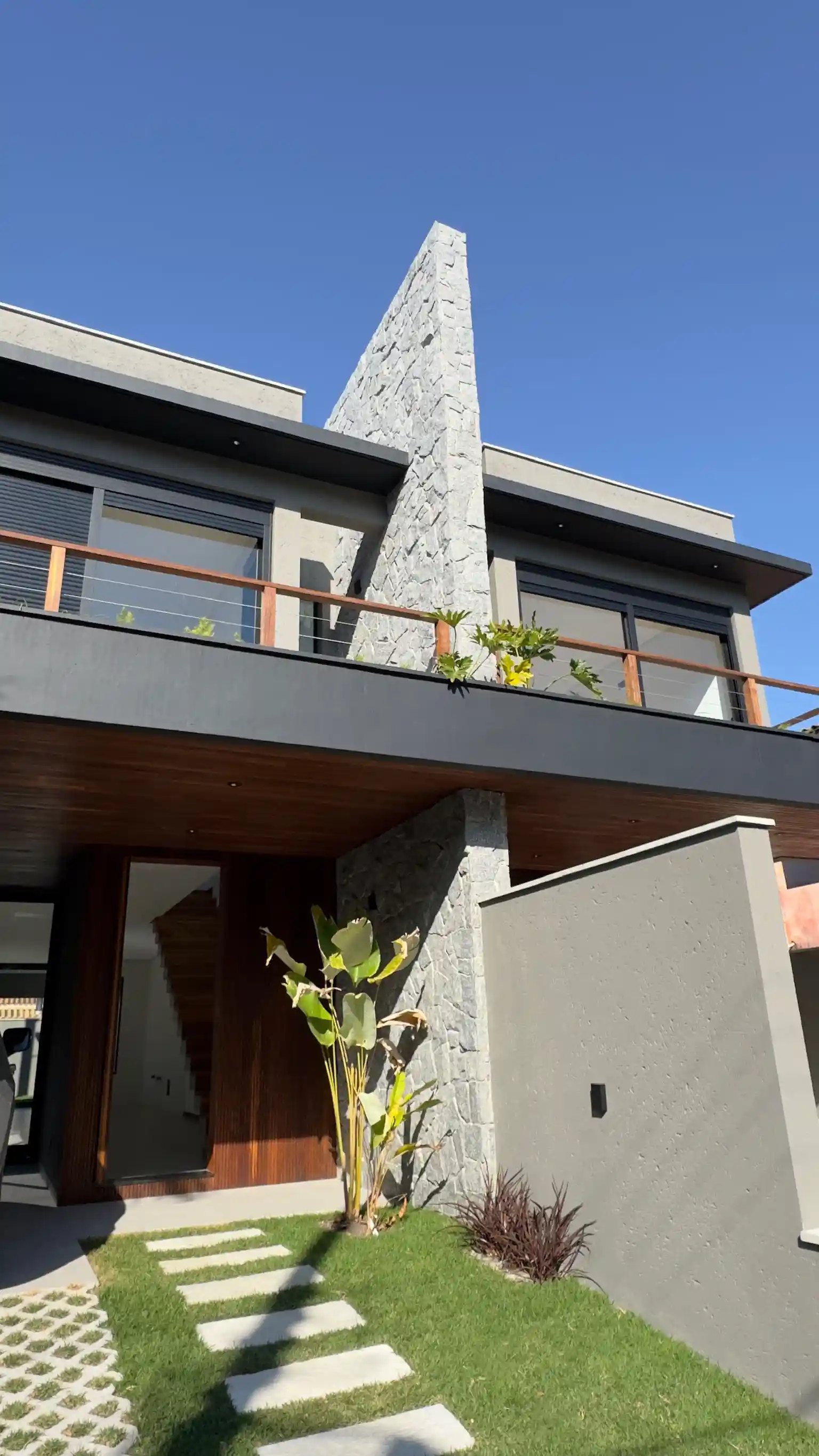
The result is a modern tropicalist design: contemporary architecture in dialogue with the landscape, facing a protected conservation area with open views to hills of native forest. Stone, natural wood, glass, and a lighting design worked out room by room.

The numbers

What you get.

360
Single lot · ≈ 3,875 sq ft
164
Private area / home · ≈ 1,765 sq ft
3 Bedrooms
1 suite + 2 demi-suites
1.1 km
To the beach · ~15 min walk
Construction & Materials

The finish tells the story.

Frames & Structure 01

  • -
    Aluminium frames with tempered glass - excellent thermal and acoustic performance
  • -
    Solid wood doors, pivoting, on a metal structure
  • -
    Details in natural slatted wood panelling

Floors & Light 02

  • -
    Lower floor in Portinari porcelain tile - quality and durability
  • -
    Upper floor in high-quality vinyl flooring
  • -
    A lighting design planned for visual comfort and to bring out every space
Walkthrough

Step inside.

The full tour

Walk the whole house - the real thing.

One continuous walkthrough of the finished, as-built home, from the entrance to the rooftop light. Tap to play.

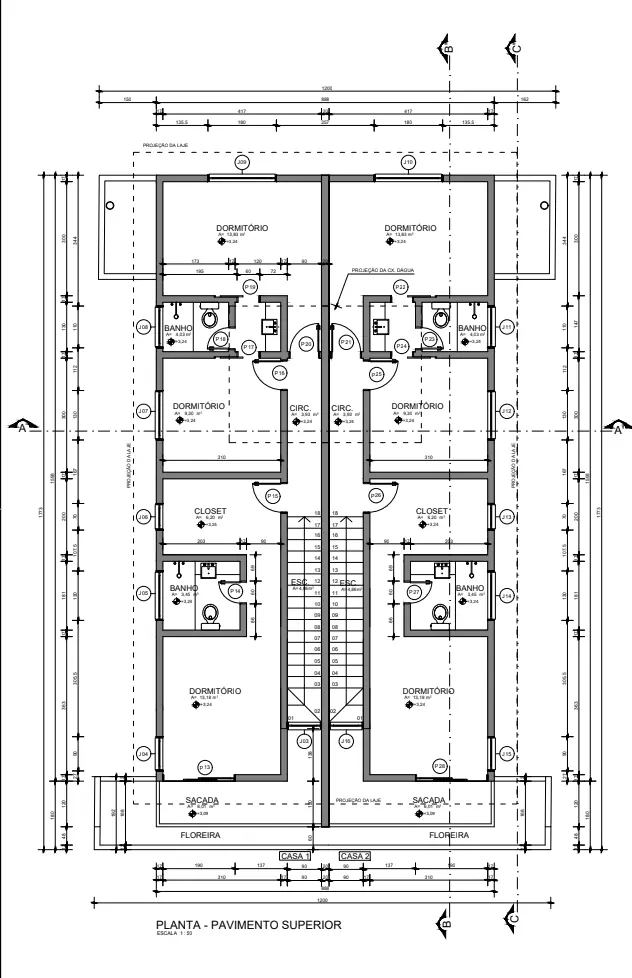
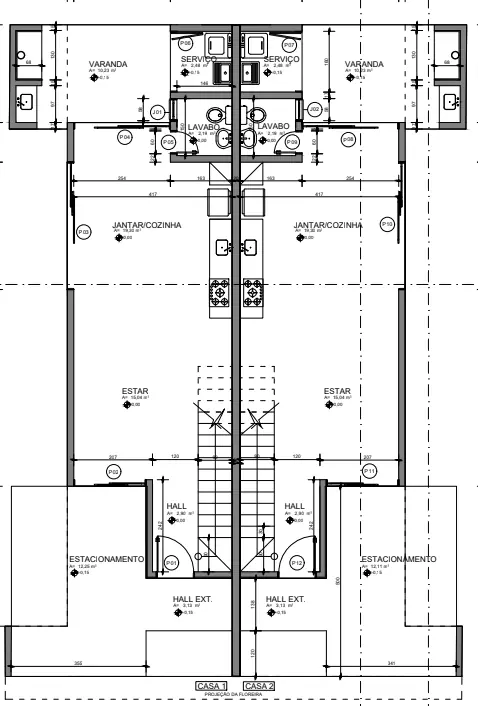
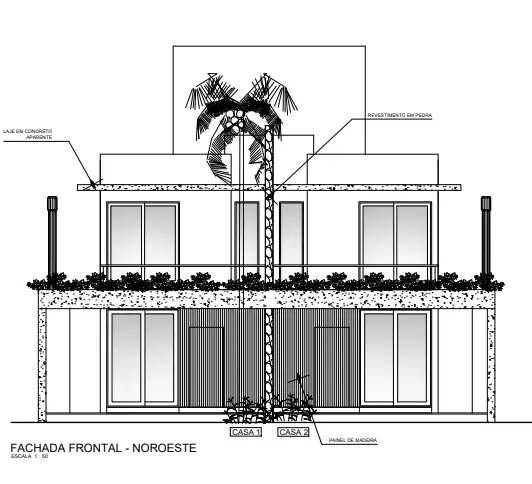
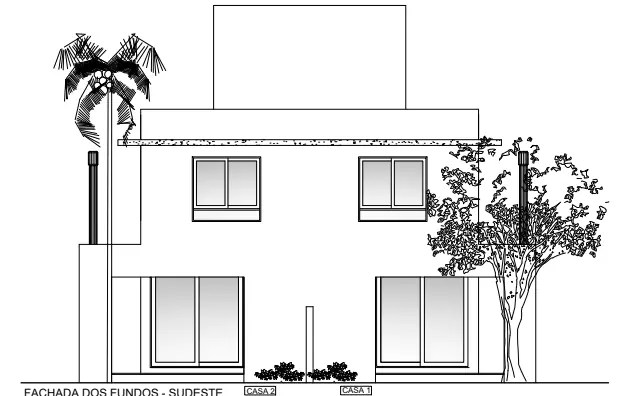
Floor plan & elevation

The layout.

Swipe or use the arrows · Tap a drawing to enlarge · Front & rear elevations, upper & ground floor plans · Registered architectural drawing

Moving to Brazil

You're not just buying a house. You're making a move.

Relocating to Brazil from the US or Europe is absolutely doable - but the paperwork, the visa, the money transfer and the language are real. The difference here is that the person selling this home lives on this island, made this move, and can point you to the right people for every part of it. Trusted introductions, not a sales pitch.

The residency angle

This home can be your path to Brazilian residency.

At R$1,700,000 (≈ US$333,000), this purchase sits above the R$1,000,000 (≈ US$196,000) real-estate threshold for Brazil's investor residency visa (the "VIPER" / golden visa) in the South region. That means the same money that buys your home can qualify you - and your spouse and children - for permanent residency, with no minimum-stay requirement and a path toward citizenship over time.

Thresholds, timelines and rules are set by Brazilian law and change periodically. This is general information, not legal advice - every case must be reviewed by a licensed Brazilian immigration lawyer (OAB-registered), and funds must be transferred through authorised Central Bank channels. We'll connect you with one.

01

Visa & residency

Introductions to immigration lawyers who handle investor visas, family reunion and digital-nomad routes - including the fast, done-right path so your registration doesn't drag on for a year.

02

Moving money in

Bringing funds from abroad into Brazil has rules - Central Bank registration, exchange channels, documentation for the visa. We'll point you to neutral third parties to structure and review the transfer, so it's clean from day one.

03

The legal side

Buying property as a foreigner, getting your CPF, notary and registration - reviewed by lawyers who do this every week, with a second set of eyes so nothing is taken on trust alone.

04

Landing softly

No Portuguese? That's most people who move here. From homeschooling families to the rugby-and-beach community, the south of the island already has a network of foreigners - and an open door into it.

Who builds it

The person behind the build.

Juan Mazzola, co-founder of AnMa Construtora

Juan Mazzola

Co-founder · AnMa Construtora (Andrade / Mazzola)

AnMa is the partnership behind Casas Açores, founded in 2021 on a single idea: design and execution held to the same obsession. Juan is the design half - a photographer's eye for proportion, light and detail - and he lives on the island, made this move himself, and runs the build on the ground.

That eye shows in what gets chosen: every material specified on purpose, not by budget - the stone, the natural wood, the glass, the lighting worked out room by room. Nothing leaves the site at "good enough". It's the difference you feel the moment you walk through.

And when you reach out, you reach a person - not a call centre - and the same network of trusted lawyers, notaries and local contacts that helps every foreign family settle here. No sales pitch.

5-year guarantee on every home AnMa delivers
How it works

From first message to keys in hand.

Buying property in Brazil as a foreigner is a known path. Here's the whole thing, start to finish.

1

Reach out

A message on WhatsApp is enough. Tell us where you're coming from and what you're looking for. You'll talk to the person who lives here - not a call centre. We answer honestly, including the awkward questions about cost, timing and red tape.

Day one
2

Visit the home & the south

Come see Casas Açores in person, walk the beach, feel the neighbourhood. We can introduce you to people already living here - the expat and homeschooling families who made the same move - so you're deciding with real context, not just photos.

When you're on the island
3

Lawyer & due diligence

Before any money moves, an independent OAB-registered lawyer reviews the property, the title, and your visa pathway. You get your CPF (Brazilian tax ID), and we help set up the Central Bank-registered transfer so your funds arrive clean and documented for the visa.

~2-4 weeks
4

Purchase & registration

Signing at the notary, registering the deed in your name at the property registry. Financing is accepted if you need it. This is the moment the home becomes yours - and the qualifying investment for your residency is on the record.

At closing
5

Residency for the family

With the purchase above the investor-visa threshold, your lawyer files for residency - for you, your spouse and your children. From there it's a path toward citizenship over the coming years. House first, visa with it, life on the island after.

Following closing
Location

Os Açores - Pântano do Sul.

The southern tip of Santa Catarina Island, between the Atlantic forest and the sea.

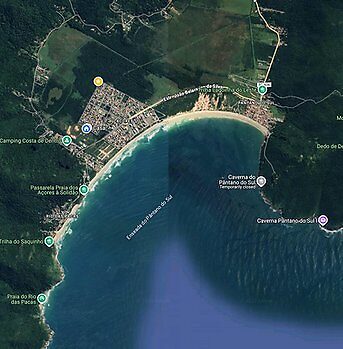
Map of Praia dos Açores and Pântano do Sul
Praia dos Açores beach1.1 km · ~15 min
Lagoinha do Leste trailheadWalkable
Conservation areaFacing it
Hercílio Luz Airport~30 min
AddressR. das Ametistas, 120
Walk to the water

A short walk to the sand.

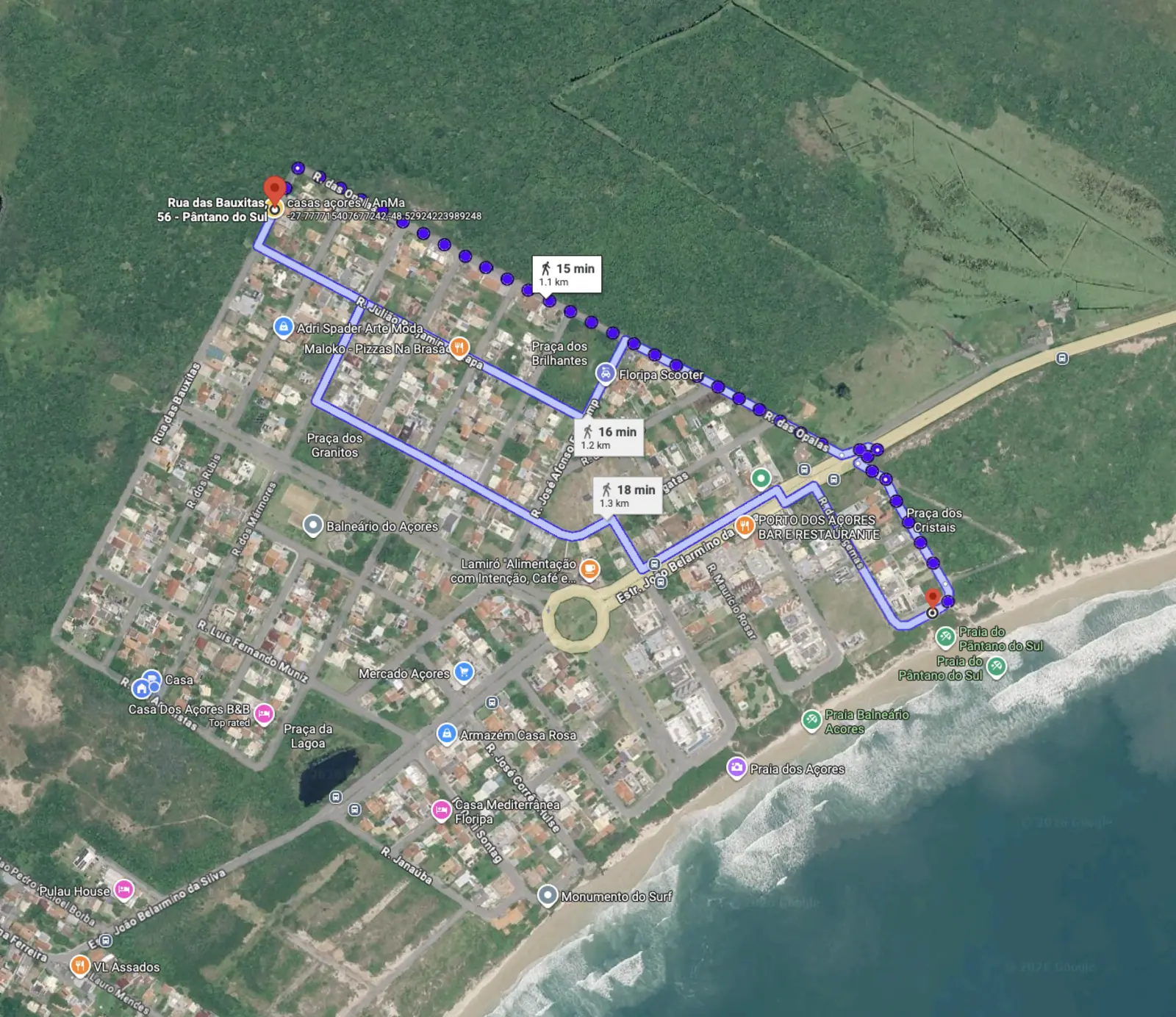
Praia dos Açores is about a 15-minute walk - roughly 1.1 km - through a quiet, low-rise neighbourhood, or a couple of minutes by bike. Two more beach accesses sit just beyond it.

Walking route from Casas Açores to Praia dos Açores, about 1.1 km and 15 minutes on foot
From the house to Praia dos Açores: about 1.1 km / 15 min on foot. Source: Google Maps.
From above

Forest on one side, the Atlantic on the other.

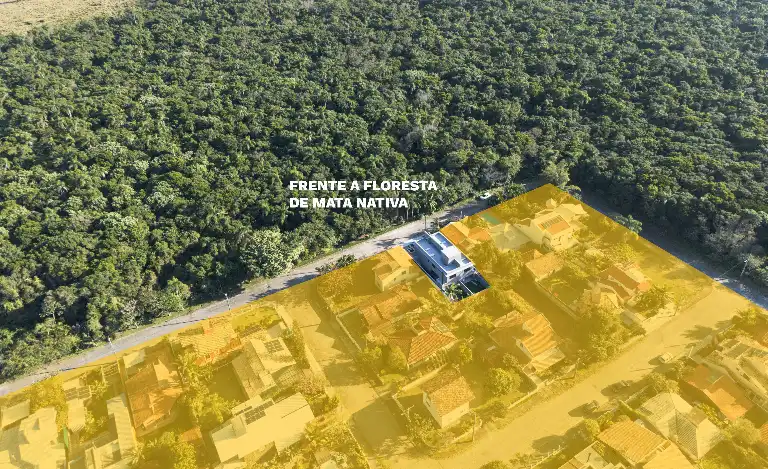
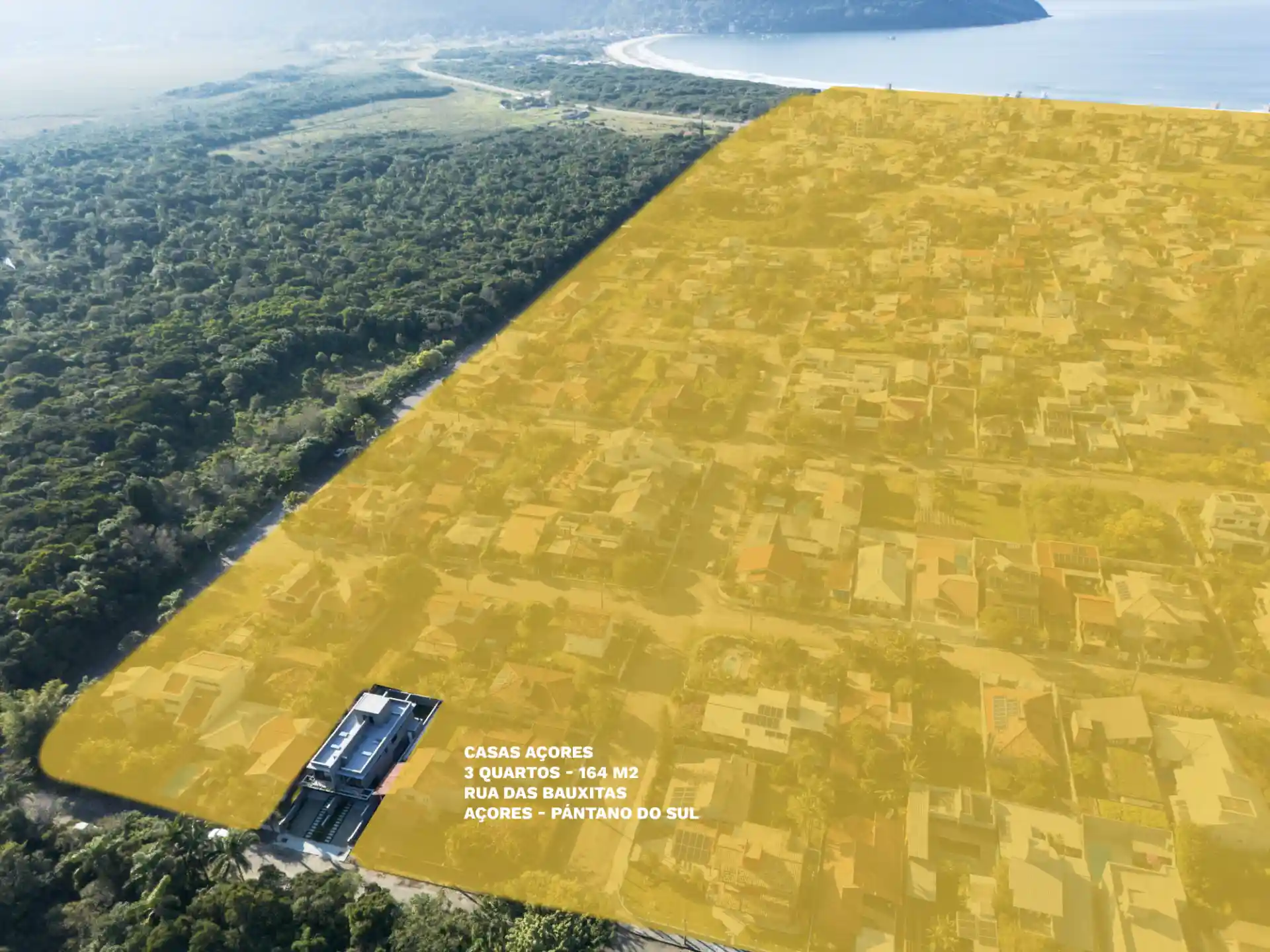
Seen from the air, the setting explains itself. The plot backs straight onto protected native Atlantic forest, while the open ocean and Praia dos Açores sit only minutes away through a low-rise, low-density neighbourhood. This is the scarce, green edge of the island - the part that can't be rebuilt once it's gone.

Aerial view of Casas Açores bordering native Atlantic forest in Pântano do Sul, Florianópolis
The plot backs directly onto protected native Atlantic forest (Mata Atlântica).
Aerial view of the Açores neighbourhood and coastline on the south of Florianópolis Island
The Açores neighbourhood meeting the coast, on the island's wild south shore.
The bigger picture

Brazil: a BRICS economy with real assets, resources and global relevance

It's easy to read a page like this and think of Brazil as a lifestyle destination - beaches, surf, sunshine, a slower way of living. All of that is true. But it's only half the story. Brazil is the largest country and the largest economy in Latin America, a founding member of the BRICS group, and one of the very few places on earth that combines scale, natural resources, food production, energy, fresh water, land and a large domestic consumer market inside a single national border. For an international buyer, that context matters: a home in Florianópolis is not only a place to live. It is a real asset inside a continental-scale, resource-rich emerging market.

Brazil belongs to the part of the world sometimes described as the Global South - economies whose weight in trade, commodities and population is rising relative to the older industrial powers. As a BRICS member alongside China, India, Russia and South Africa (and a widening circle of partner nations), Brazil sits inside the conversation about a more multipolar global economy, where supply chains, energy and food security are being rethought. You don't have to take a strong political view on any of that to notice the underlying point: the country is structurally relevant in ways that go far beyond tourism.

A coastal property in Florianópolis sits at the intersection of lifestyle, hard assets, emerging-market exposure and long-term scarcity.

Consider what Brazil actually produces. It is one of the world's agricultural superpowers - a leading exporter of soybeans, beef, coffee, sugar, poultry and orange juice, feeding a large share of the planet. It is a major energy player, with deep-water oil, one of the cleanest electricity mixes among large economies thanks to hydropower, and a fast-growing wind and solar base. It holds some of the largest fresh-water reserves in the world. It has a serious aviation industry in Embraer, a deep mining sector, and an industrial base that few emerging markets can match.

Brazil is also highly relevant in strategic minerals. It holds an exceptionally strong position in niobium - producing roughly 90% of the world's supply and holding the large majority of known global reserves - a metal used to strengthen steel for pipelines, vehicles, aerospace and advanced engineering. It is increasingly discussed in the context of rare earths and other critical minerals that matter for electronics, defence and the energy transition. These are the kinds of resources that shape long-term geopolitical relevance.

For investors looking beyond Europe and North America, this is the frame that's often missed. Brazil is not just a lifestyle market. It is a BRICS economy with food, energy, water, minerals, a large internal consumer base and a growing role in global supply chains. And within Brazil, Santa Catarina adds a more specific angle: one of the country's most organised, safest and highest-quality-of-life states, with strong public indicators, a diversified economy and a European-influenced culture. It's the part of Brazil that feels stable and structured - which is exactly what many international buyers are looking for when they commit to a place for the long term.

None of this is a promise about prices. Markets move, currencies move, and every buyer should verify current data and legal requirements for themselves. But as a piece of context for the decision, it's worth holding in mind: when you buy here, you're buying a real asset in a country that combines scale, resources and genuine global relevance - with a coastline that happens to be one of the most beautiful in the Americas.

This section is general macroeconomic context, not financial, legal or investment advice. Figures such as commodity shares change over time and should be verified against current sources before relying on them.

Silicon Island

Florianópolis: Brazil's startup capital by the sea

Florianópolis is not only a beach city. It is one of Brazil's strongest innovation hubs, and in 2024 it was officially recognised by federal law as the country's National Startup Capital - Capital Nacional das Startups. That isn't marketing language; it's written into Brazilian law (Lei 14.955/2024), and it reflects something real: the island has one of the highest densities of technology companies per capita in the country, ahead of much larger cities.

That creates a rare mix. In most of the world, you choose between an ocean-lifestyle town and a real tech economy. Here you get both: surf in the morning, coworking by midday, university talent coming out of UFSC and UDESC, international founders, remote workers, cafés, sports culture and a genuine ecosystem of software, gaming, fintech and health-tech companies. The Sapiens Parque innovation district, the ACATE technology association and the annual Startup Summit have helped turn a scenic island into a place where companies are actually built and scaled.

It's often called the Silicon Valley or Silicon Island of Brazil. That nickname is the softer, narrative version of the story - a flattering comparison rather than a literal equivalence. The harder, documented claim is the one that matters for buyers: Florianópolis is Brazil's officially recognised startup capital, and it has the company density, the talent pipeline and the digital culture to back it up.

Demand here is not based only on tourism. It's also supported by people who want to live, work and build companies on the island.

For real estate, tech-city status is more than a fun fact. It changes who the buyers and renters are. A purely touristic beach town lives and dies by the season: prices spike in summer, demand evaporates in winter, and the local economy is thin. An innovation hub behaves differently. It draws higher-income residents, entrepreneurs and mobile professionals who want to stay year-round - people earning in strong currencies, building companies, and choosing the island as a base rather than a holiday. That underlying, non-seasonal demand is part of what gives Florianópolis property its resilience compared with one-dimensional resort markets.

It also shapes the kind of community you move into. The south of the island, where Casas Açores sits, has quietly absorbed a slice of exactly this population: remote workers, founders, designers and digital professionals who wanted the nature of the south without giving up their careers. They're online for work, in the water at sunset, and raising families in a place that combines real economy with real quiet. When people ask why a relatively small island in southern Brazil keeps attracting international attention, this is a large part of the answer - it's not just pretty, it's productive.

Florianópolis attracts founders, software people, remote workers, digital nomads and international families because it offers something most cities can't: a credible place to build a company and a genuinely beautiful place to build a life, at the same time. For a buyer, that dual identity is one of the strongest long-term arguments the island has.

Connected island

Airport, internet exchange and global mobility

Floripa feels like an island escape - nature-rich, relaxed, a little hidden. But it is not remote in the way many beach destinations are remote. That combination is rarer than it sounds: most places that feel this far from the noise also feel far from everything else. Florianópolis manages to be both peaceful and genuinely connected, which is precisely what makes it workable for international families and location-independent professionals.

The island is served by Hercílio Luz International Airport, a modern terminal about thirty minutes from the south of the island. From there, the connections are real. TAP Air Portugal flies a direct route to Lisbon, giving Florianópolis a direct European gateway - a roughly eleven-hour hop that puts the whole of Europe one connection away. Copa Airlines flies a direct route to its hub in Panama City, which opens up convenient one-stop access onward to North America and the Caribbean. And domestically, frequent links to São Paulo, Rio and other Brazilian hubs keep you plugged into the country's main cities.

Flight routes and frequencies change with the seasons and over time. Confirm current schedules with the airlines before relying on any specific connection.

There's also a quieter piece of infrastructure that matters enormously to remote workers: Florianópolis hosts an IX.br internet exchange point - one of the nodes in Brazil's national network of traffic-exchange points. In plain terms, it means local networks interconnect efficiently on the island itself, which supports faster, more reliable connectivity. For a founder running a company, a designer on calls across time zones, or a family schooling children online, that's not a detail. It's the difference between an island that looks good on Instagram and one you can actually run a business from.

Nature, beach and slower living - without cutting yourself off from global mobility.

Put it together and you get an unusual profile: an island escape with an international airport, a direct European route through Lisbon, one-stop access to North America via Panama, frequent domestic links, and a local internet exchange strengthening the digital backbone. For remote workers, founders, online business owners and digital nomads, that mix is powerful. You get the morning surf and the forest at your door, and you keep the world within reach. The south of the island gives you the quiet; the airport and the fibre give you the option to leave and to work - whenever you want.

Lifestyle value

Premium quality of life without Europe or US pricing

Let's be honest up front: Florianópolis is not the cheapest city in Brazil, and pretending otherwise would do you no favours. It is a premium Brazilian coastal city - one of the most desirable in the country - and prices reflect that. The south of the island, with its scarcity and its nature, is not a bargain-bin location. So if you're comparing Floripa with the interior of Brazil or a sleepy town in the northeast, it will look expensive.

But that's the wrong comparison for most international buyers. The real comparison is with the coastal lifestyle-and-tech markets people actually weigh Florianópolis against: coastal California, Miami, the Algarve and Lisbon in Portugal, parts of Spain, the surf towns of Australia. Against that set, Floripa can still offer a compelling quality-of-life equation. Surf, private healthcare access, restaurants, cafés, sports, nature, domestic help options and a real international community - at a cost structure that often remains attractive for households earning in dollars, euros or pounds.

A few everyday figures make it concrete. These are current reference prices for Florianópolis and they vary by neighbourhood, season and lifestyle - they are a snapshot, not a quote.

Everyday itemFlorianópolis (approx.)≈ in US$
Meal, inexpensive restaurantR$ 45≈ $9
Mid-range dinner for two, three coursesR$ 235≈ $46
CappuccinoR$ 12.5≈ $2.5
Soft drink (0.33L bottle)R$ 6.8≈ $1.3
Estimated monthly costs, single person (excl. rent)R$ 3,300≈ $650
Estimated monthly costs, family of four (excl. rent)R$ 12,200≈ $2,400

Indicative figures (Numbeo, 2026), excluding rent. USD at ≈ R$5.1/US$1. Prices vary and should be checked against current sources before you plan around them.

What the numbers don't capture is the texture of daily life. A casual lunch by the beach, a proper dinner out for two, a good flat white in a designer café, fresh produce from a feira - these are the small, repeated costs that quietly define quality of life, and in Floripa they remain gentle relative to North American and Western European cities. Rent and property prices are the wild card: they swing heavily by neighbourhood, and the most desirable coastal pockets command real premiums, so any housing figure should be checked locally for the specific area you're considering.

Floripa is not a low-cost backwater. It's a premium coastal city - and still a strong quality-of-life equation for foreign-income households.

The honest summary is this. Florianópolis won't be the cheapest line on a spreadsheet, and it shouldn't be sold that way. What it offers is value of a different kind: a premium, safe, beautiful, tech-enabled coastal life at a cost structure that, for someone earning abroad, often still feels generous compared with the equivalent lifestyle in Europe or the United States. You're not buying cheap. You're buying a lot of life per unit of money - which, for a place this connected and this beautiful, is the comparison that actually counts.

Cost-of-living figures are indicative and change frequently. Always verify current prices via sources such as Numbeo or Expatistan, and budget for your own situation.

The scarcity case

Limited island supply: why South Florianópolis has long-term real-estate logic

Here is the core of the long-term argument, stated plainly and without hype. Florianópolis is an island. That single fact changes the economics of property in a way that's easy to overlook when you're looking at photos of the coastline. An island has a hard edge to its supply - and Florianópolis has an unusually hard one.

The most desirable land here is constrained on every side. There are environmental protections and conservation areas. There are beaches, dunes, lagoons and lakes that can't be built on. There are steep hills and morros that resist development. And there is the Atlantic Forest - the Mata Atlântica - wrapping the coast in protected native vegetation. Add it all up and the buildable land in the best coastal zones is genuinely finite. You cannot manufacture more oceanfront on an island whose nature is, by law and by geography, off-limits to the bulldozer.

At the same time, demand keeps arriving from several directions at once: Brazilians from São Paulo and the south seeking a higher quality of life, entrepreneurs and remote workers drawn by the startup economy, international buyers and lifestyle migrants, and young families wanting to raise children near nature. Limited, constrained supply meeting broad, rising demand is the most basic engine of long-term value in real estate. It's not a guarantee - nothing here is - but it is a logic worth understanding before you decide where on the island to commit.

The island's own history shows how that logic has played out by neighbourhood. Jurerê, in the north, became the obvious premium and luxury market - the established, high-priced, brand-name destination. Campeche, in the centre, has already moved strongly on the back of surf culture, airport proximity, infrastructure and lifestyle demand; in many ways it has repriced from an insider's secret into one of the island's hottest markets. And the south - including Açores - remains the lesser-known, quieter, more nature-driven part of the island, less obvious to international buyers and less intensely developed.

Buyers here aren't only buying a house. They're buying scarce access to a lifestyle zone that can't be rebuilt once it's gone.

It's tempting to draw a straight line and say the south will simply repeat what happened in Campeche. That would be overclaiming, and we won't. What we can say carefully is this: Açores may be interesting for buyers looking for a quieter, earlier-stage lifestyle location compared with the more established premium neighbourhoods such as Jurerê and Campeche. The south is less urbanised, more natural, and offers a different type of scarcity - not the scarcity of a finished luxury enclave, but the scarcity of genuinely quiet, green, walk-to-the-beach coastline on an island that keeps filling in elsewhere.

The table below lays out the island's main lifestyle zones honestly - what each one is, who it tends to suit, and the underlying logic behind it. It's not a ranking. Different buyers want different things, and the "best" neighbourhood is the one that matches how you actually want to live.

NeighbourhoodPositioningBuyer profileUnderlying logic
JurerêLuxury, high prices, established premium marketBuyers wanting brand-name prestige, beach clubs and nightlifeMature, fully priced luxury enclave in the north
Lagoa da ConceiçãoLifestyle, nightlife, central, international - but busySocial buyers who want energy, restaurants and a sceneVibrant and central, with the trade-offs of crowds and noise
CampecheSurf, airport proximity, strong infrastructure - already repricedLifestyle and rental-yield buyers comfortable with urbanisingProven demand story; much of the early upside already realised
AçoresQuiet, natural, surfable, lesser-knownFamilies, surfers, remote workers wanting nature over nightlifeEarlier-stage scarcity and lifestyle in the protected south
Pântano do Sul / SolidãoUltra-local, nature, traditional fishing-village atmosphereBuyers wanting authenticity and the least-urban settingDeeply local, low-density, nature-first corner of the island

Positioning is descriptive and general. Neighbourhood dynamics and prices change - verify current local market data before acting.

So when buyers ask whether the south of Florianópolis "makes sense" as a long-term decision, the honest answer is a logic, not a promise. The island can't grow more protected coastline. The desirable zones are finite. Demand is broad and structural. And the south still holds the rarest version of the island's appeal - quiet, green, untouched coast within walking distance of the sand. For buyers who believe in the long-term Florianópolis story but don't want the most crowded or already fully priced locations, that combination is the entire point. You should still verify the market data and the legal requirements yourself. But the underlying scarcity is real, and it's the kind of thing that tends to matter more, not less, as the years pass.

This is general market context, not a forecast or a guarantee of appreciation. Real estate values can fall as well as rise. Verify current market data and legal requirements, and take independent professional advice.

The lesser-known play

Açores: the lesser-known surf and nature play

Açores is not the loudest name in Florianópolis real estate, and that is part of its appeal. It doesn't have the fully developed brand of Jurerê or the already-intense demand profile of Campeche. It isn't flashy, it isn't mass-market, and it doesn't trade on luxury branding. What it offers instead is quieter, more natural, surf-oriented and community-driven living in the south of the island - the version of Florianópolis that the people who know the island best tend to keep for themselves.

This is a place defined by what it doesn't have as much as what it does. No high-rises. No wall of beach clubs. No need to drive through traffic to reach the sand. Instead: a surfable beach a short walk away, protected forest across the road, the Três Irmãs islands on the horizon, and trails into the hills that start from the neighbourhood itself. It suits a specific kind of buyer - families who want their kids outdoors, surfers who want the water at their door, remote workers who want focus and nature, and people who simply don't need nightlife waiting at the gate.

For the right buyer, being slightly early in a quieter, more authentic location can be more valuable than being in the obvious one.

That's the honest pitch for the south. It's not for everyone, and it shouldn't be. If you want a scene, Lagoa or Jurerê will serve you better. But if you believe in the long-term story of Florianópolis - the scarcity, the lifestyle, the growing international visibility - and you'd rather not pay the fully-priced premium of the obvious neighbourhoods, Açores offers a different type of scarcity and a more authentic way of living on the island. It rewards the buyer who values nature, community and quiet over branding and buzz. For that person, the south isn't a compromise. It's the whole reason to come.

Surf & nomad lifestyle

Florianópolis vs Bali: the surfer's lifestyle, without the gridlock

For a decade, Bali was the default answer to a single question: where can a surfer, a remote worker or a young family go to trade a grey commute for warm water, cheap good living and a global community? It worked - until it worked too well. In 2025 Bali received more than seven million foreign visitors, a record. With that came the part nobody puts on a postcard: traffic in Canggu, Ubud and Uluwatu that can turn a few kilometres into a multi-hour crawl, rising prices, construction where the rice fields used to be, and a steady stream of nomads now openly searching for "the next Bali" - somewhere quieter, cleaner and closer to how the island felt before the boom.

The south of Florianópolis is one honest answer to that search. Not a tropical copy of Bali - it isn't, and pretending otherwise would be dishonest - but a place that offers the same core promise Bali once did: real surf, real nature, a real international community, and a good life that still feels uncrowded. Praia dos Açores and the beaches around it carry the feeling a lot of people are chasing: untouched coast, forest coming down to the sand, waves for every level, and a pace that hasn't been paved over. It's the "before" version that Bali's veterans talk about with nostalgia.

Bali sells the surfer-and-nomad dream at full capacity. The south of Floripa still sells it with room to breathe.

Where Florianópolis genuinely pulls ahead is the boring, decisive stuff: infrastructure and connectivity. This is a city on a developed island in an organised Brazilian state, not a strained network of village roads. It has an international airport with a direct route to Lisbon and a direct Copa route to Panama, a startup economy that is officially Brazil's National Startup Capital, an IX.br internet exchange strengthening the digital backbone, private healthcare, and the everyday systems of a real city. You get the wildness of the south and the functioning city behind it - the combination Bali increasingly struggles to hold together as it scales.

It's only fair to name the trade-offs, because they're real and they filter for the right buyer. The water in the south of Brazil is cooler than Bali's bath-warm Indian Ocean, and Floripa has genuine seasons - a proper summer, a cooler winter - rather than year-round tropics. The first language is Portuguese, not the English-first tourism bubble of Canggu. For some, those are deal-breakers. For many surfers and families, they're exactly the point: fewer crowds, a real culture to live inside, and a place that feels like somewhere rather than a content backdrop.

There's one more dimension that increasingly draws internationally mobile families, and it deserves careful, accurate wording. Brazil is one of the countries that recognises citizenship by birth on its soil - jus soli. A child born in Brazil is a Brazilian citizen from birth, regardless of the parents' nationality. Being the parent of a Brazilian child, in turn, opens a recognised path to permanent residency for both parents, and over time toward naturalisation. Some international families factor this into a long-term move to a place like Florianópolis - alongside the separate, property-based investor-residency route already described on this page, and the standard time-based residency paths.

Citizenship and residency rules are set by Brazilian law, are legally sensitive, and change over time. None of this should be treated as a shortcut or as the sole reason for a move, and every case must be reviewed by a licensed Brazilian immigration lawyer (OAB-registered). This page is general information, not legal or immigration advice.

Put the whole picture together and the comparison resolves cleanly. If you want the maximum-density, English-bubble, tropical-at-all-costs version of the nomad dream, Bali still has it - traffic included. If you want the surfer-and-family lifestyle with uncrowded waves, a functioning connected city, an organised state, cooler-but-cleaner nature and a serious long-term residency story, the south of Florianópolis is a credible, and quieter, alternative. For the right person, that isn't a downgrade from Bali. It's the upgrade they were actually looking for.

Families & education

Families, worldschooling and alternative education mindsets

Florianópolis attracts many families who think differently about childhood, education and lifestyle. Some are interested in bilingual schools, some in international curricula, some in tutoring or online learning, and some come from the broader worldschooling and remote-family movement that has grown alongside location-independent work. The south of the island, in particular, has quietly become home to a community of international families exploring more flexible ways of raising and educating children.

It's important to be careful and precise here, because education is a legally sensitive area. Brazil has compulsory education rules, and homeschooling should not be presented as a simple, plug-and-play solution or assumed to work the way it might in another country. It is a legally sensitive topic that should be reviewed with a qualified local advisor before you make any plans around it. International families exploring flexible learning typically look at a mix of options - bilingual and international schools, private tutoring, online curricula - and seek proper local legal and education advice rather than assuming. This page does not provide legal advice, and nothing here should be read as encouragement to ignore local school rules.

Brazil has compulsory education rules and homeschooling is a legally sensitive topic. Seek qualified local legal and education advice for your specific situation. This page is not legal advice.

With that clearly said, the broader point is real and worth stating. Floripa attracts parents who want their children to grow up with more nature, more sport, more languages, more community and more time outside - surfing after school, speaking two or three languages, raised in a place where the forest and the ocean are part of daily life rather than a holiday. That's the deeper draw, and it's why the south of the island already holds a network of like-minded families. You wouldn't be arriving alone; you'd be joining people who made the same choice and worked out the practicalities - including the legal ones - with the right local guidance.

A forward look

Built for a more mobile future

Over the next decade, global mobility is likely to keep changing. Aircraft technology, route networks and international work patterns may make seasonal living between continents more normal for entrepreneurs, remote workers and families - splitting the year between Europe, North America and Brazil in a way that once seemed impractical and increasingly simply isn't. We won't make hard predictions about how much faster or cheaper that travel will become, and the case for buying here doesn't rest on any future generation of aircraft. This is a lifestyle thought, not an investment claim.

But it's a thought worth holding. A place like Florianópolis fits that more mobile future well: connected enough to reach, relaxed enough to stay, and rich enough in nature to make long stays genuinely meaningful. If the world keeps moving toward flexible, multi-continent living, the islands and coastlines that combine real connectivity with real escape are the ones that will keep their pull. The south of Florianópolis is quietly one of them.

Explore the topics

Dig deeper into the Brazil & Florianópolis story

Sources & references
Questions & answers

What buyers ask about Brazil, Florianópolis and Açores.

Straight answers, carefully worded. None of this is financial, legal or immigration advice.

Can a foreigner buy a house in Brazil?

Yes. Foreigners can buy property in Brazil freely, with essentially the same rights as Brazilian citizens for urban real estate like this. You'll need a Brazilian tax ID (CPF), and the purchase is completed through a notary (cartório) and registered on the property's title. We connect you with the lawyers and notary who handle this every week. This is general information, not legal advice.

How much does it cost, in USD, to buy a house in Brazil?

It depends entirely on location and type. Casas Açores is priced at R$1,700,000 per home (≈ US$333,000 at ~R$5.1/US$1). That figure is deliberate: it sits just above the R$1,000,000 threshold that makes the purchase eligible for Brazil's investor residency visa. USD figures are approximate and move with the exchange rate.

Can I get Brazilian residency by buying property?

Yes - real estate is one of the recognised routes. A purchase above R$1,000,000 (≈ US$196,000) in Brazil's South region can qualify the buyer - and spouse and children - for an investor residency visa, with no minimum-stay requirement and a path toward citizenship over time. At R$1,700,000, this home is above that threshold. Thresholds and rules are set by Brazilian law and change periodically; every case must be reviewed by a licensed (OAB-registered) immigration lawyer. Not legal advice.

Is it cheaper to live in Brazil than the US or Europe?

For most international buyers, yes. Everyday costs - housing, food, services, healthcare - are generally well below comparable US and Western-European levels, while the south of Florianópolis offers a high quality of life by the sea. Your exact savings depend on lifestyle and the exchange rate.

Why is Florianópolis called Brazil's Startup Capital?

Because it earned the title in law. Florianópolis was officially recognised as Brazil's National Startup Capital (Capital Nacional das Startups) by federal law in 2024. The island has one of the highest concentrations of technology companies per capita in the country and a dense ecosystem of founders, software professionals and remote workers - which is why local demand isn't based on tourism alone.

Is Florianópolis really the Silicon Valley of Brazil?

Florianópolis is often called the Silicon Valley or Silicon Island of Brazil. That's a narrative nickname rather than an official title. The hard, documented claim is that it is Brazil's officially recognised National Startup Capital, with a strong tech and innovation economy by the sea.

Why does BRICS matter for Brazil real estate?

BRICS matters because it places Brazil inside a larger geopolitical and economic story around emerging markets, resources, trade and multipolar investment flows. For real-estate buyers, this does not replace local due diligence, but it adds macro context: Brazil is a continental-scale economy with food, energy, water, minerals and a large internal market.

Is Brazil a good country for long-term real-estate diversification?

Brazil can offer exposure to a large, resource-rich emerging market with a real-asset (property) component. No outcome is guaranteed. Buyers should verify current market data, currency considerations and legal requirements, and treat any purchase as part of a diversified strategy rather than a guaranteed return. This page is not financial advice.

Does Florianópolis have good internet infrastructure?

Yes. Florianópolis hosts an IX.br internet exchange point, which strengthens local digital infrastructure and connectivity. Combined with its startup ecosystem, this makes the island attractive to remote workers, founders and online business owners.

Are there direct flights from Florianópolis to Europe?

Yes. TAP Air Portugal operates a direct route between Florianópolis (FLN) and Lisbon (LIS), giving the island a direct European gateway. Schedules change seasonally, so confirm current routes and frequencies before relying on them.

Can I reach North America from Florianópolis easily?

Florianópolis has a direct Copa Airlines route to Panama City, which provides convenient one-stop access onward to many destinations in North America and the Caribbean. Route availability changes over time and should be verified for current schedules.

Is Açores cheaper than Jurerê or Campeche?

Açores is generally quieter and less internationally branded than Jurerê or Campeche, and is often less obvious to foreign buyers. Pricing varies by property, plot and timing, so direct figures should always be checked against current local market data.

Why is buildable land limited in Florianópolis?

Florianópolis is an island with environmental constraints, protected nature, beaches, dunes, lakes, hills and Atlantic Forest. These naturally limit how much land can be built in the most desirable coastal zones, which supports the long-term scarcity narrative in premium areas.

Is Açores still lesser known compared with Campeche?

Yes. Campeche has already moved strongly as a lifestyle and surf-driven market, while Açores remains quieter, more natural and more local. For buyers who believe in the long-term Florianópolis story but prefer an earlier-stage, less crowded South Island location, that difference can be part of the appeal.

Are property prices in Florianópolis rising?

Florianópolis has structural scarcity, high quality of life and growing international visibility, and recent market reports have documented price growth in parts of the island. However, no appreciation is guaranteed, and buyers should verify current data and take professional advice.

Is homeschooling legal in Brazil?

Brazil has compulsory education rules and homeschooling is a legally sensitive topic. It should not be presented as a simple plug-and-play solution. International families should seek qualified local legal and education advice. Many families explore bilingual schools, tutoring, online curricula and worldschooling-style approaches. This page does not provide legal advice.

Is Florianópolis a good alternative to Bali for surfers and digital nomads?

For many people, yes. The south of Florianópolis offers real surf, untouched nature and an international community, but with a functioning connected city behind it - an international airport, a direct Lisbon route, a direct Copa route to Panama, official Startup-Capital status and an IX.br internet exchange. It is not a tropical copy of Bali: the water is cooler, there are real seasons, and the first language is Portuguese. But it offers the surfer-and-nomad lifestyle with far less of the traffic and overtourism Bali now struggles with.

If my child is born in Brazil, can the family get Brazilian citizenship or residency?

Brazil recognises citizenship by birth on its soil (jus soli): a child born in Brazil is a Brazilian citizen from birth, regardless of the parents' nationality. Being the parent of a Brazilian child opens a recognised path to permanent residency for both parents, and over time toward naturalisation. This is legally sensitive, should never be treated as a shortcut, and every case must be reviewed by a licensed Brazilian immigration lawyer. This page is general information, not legal or immigration advice.

Is this property suitable for a seasonal lifestyle between Europe and Brazil?

Many international buyers use Florianópolis for seasonal living. The island combines a relaxed, nature-rich lifestyle with real connectivity - a direct Lisbon route to Europe, one-stop access to North America via Panama, and strong digital infrastructure - which makes splitting the year between continents practical for families, founders and remote workers.

Is this investment guaranteed to appreciate?

No real estate appreciation is guaranteed. However, Florianópolis has structural scarcity, high quality of life, growing international visibility and documented price growth in recent market reports. Buyers should verify current data and take professional advice. This page is not financial, legal or immigration advice.

The property behind the story

One home where Brazil, surf, family life and island scarcity meet.

Everything above is the bigger picture. This is the specific opportunity: Casas Açores - two architect-built homes, a short walk from Praia dos Açores in the protected south of Florianópolis, at R$ 1,700,000 (≈ US$ 333,000) each, above the threshold for Brazil's investor residency visa. If you're looking for a property that combines Brazil real estate, surf lifestyle, family life and long-term island scarcity, request the full details and speak directly with the owner - a local contact who lives on the island, in English, Spanish or Portuguese.

Explore whether this Açores property fits your Brazil relocation, investment or residence strategy. Figures are indicative; this page is general information, not financial, legal or immigration advice.

Let's talk

Come see it. Or just ask anything.

Message us on WhatsApp to arrange a visit or ask about the home, the area, or what moving here actually involves. Straight answers, same person who lives on the island.

Financing accepted Visits welcome English spoken
Casas Açores facade against the forested hills
×